The DTC Podcast
Hiya co-founder · Podcasts & speaking
Adam Gillman
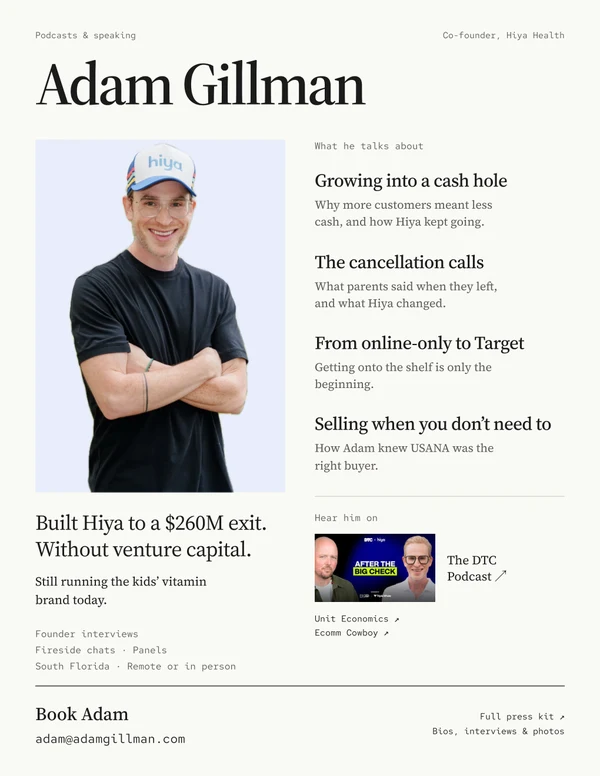
Built Hiya to a $260M exit.
Without venture capital.

Cash flow, subscription and selling Hiya.
Inside Hiya.
Adam ran the warehouse, the cash and the subscription business. Start there.

The cancellation callsKids liked different flavors. Hiya started packing custom mixes by hand.
Kids liked different flavors. Hiya started packing custom mixes by hand.
Hiya only sold by subscription, made canceling easy and refunded anyone who asked. A real person talked to every customer who canceled and asked why. One of the most common answers: the kid liked some flavors and not others. So Hiya started packing custom flavor mixes by hand, green apple on Tuesdays and Fridays, berry on Wednesdays. Adam's math on the extra cost was simple: if it keeps a family one more month, it's paid for itself. He'll also cover how to tell whether a product should be sold by subscription in the first place.
Retention, subscription and ecommerce shows
The U-Haul nightAdam drove to a failing warehouse and took Hiya’s inventory back himself.
Adam drove to a failing warehouse and took Hiya’s inventory back himself.
The founder story: a vitamin label with two teaspoons of sugar, a coffee on a bench in LA, and a launch on the day the world shut down. “At the time it was terrifying. We thought the entire world was falling apart.” Then the night Adam drove a U-Haul to take his inventory back from a warehouse that kept getting orders wrong. Bringing fulfillment in-house is what later made the custom flavor packs possible.
Founder-story and long-form shows
More conversation ideas
Building Hiya without venture money
Hiya never raised venture money. It grew on its own cash and then debt, and still got to a $260M valuation. Adam has also seen the other path up close, at an earlier company that raised venture money and grew too fast. His line is that most consumer brands are great businesses and bad venture bets. He'll walk through the few cases where he would raise: years of R&D or regulatory approval before you can sell, a race only one company can win, building out retail at scale, or founders with no track record to borrow against. Wanting to spend more on ads isn't one of them.
Founder and investor shows
Growing into a cash hole
Every new Hiya subscriber got half off their first month. So for a long stretch, the faster Hiya grew, the further behind it got on cash, and Adam spent that time finding money to keep going. “We had to hold our breath underwater for a long time before we were able to come back up to breathe.” This episode is about cash: how long a new customer takes to pay back what you spent to get them, why Adam watches that before revenue, and why he thinks revenue growth is the easiest number to fake.
Operator, ecommerce and finance shows
One product for years
While other brands launched new products every season, Hiya sold one multivitamin for its first few years. It kept reformulating that one product based on why people canceled. When Hiya did add products, it only made the ones enough customers had asked for in surveys, so new launches rarely missed. Adam talks about when to add a second product, and how to tell if it'll bring in new customers or just shift sales from the product you already have.
Founder and product shows
From online-only to Target
“In DTC, when you find something that's working, you control the throttle. With retail, you don't.” Hiya went into Target in 2026 after years of selling only through its own site, and Adam says they knew nothing about retail going in. In his experience, getting on the shelf is the easy part and getting product to move off it is the hard part.
CPG, retail and grocery shows
Selling when you don't need to
Hiya was profitable when the founders started talking to buyers, so they went in with a simple position: if they found the right partner, great, and if not, they'd keep running it. They hired a bank, met a lot of buyers (“you have to kiss a lot of frogs before you find your prince, if you even do”) and knew after the second meeting with USANA. His test for a buyer: everyone tells you what you want to hear, so look for the one that needs what you can do.
Founder, M&A and investor shows
The anxious founder
Adam calls himself “a pretty anxious guy.” The difference, he says, is that he does the scary thing anyway. He runs Hiya on the same values he's raising his sons on. The first is transparency: “every single person sees every single one of our numbers.” He'll also talk about kindness, and where it has to stop.
Leadership, mindset and parenting shows
Ready for your show.


For hosts & organizers
Bios & introductions
One-line bio
Adam Gillman co-founded Hiya Health and built the kids' vitamin brand to a $260M exit without venture capital.
Podcast intro
My guest co-founded Hiya Health, the kids' vitamin brand that launched on the day the WHO declared a pandemic. He and his co-founder never took venture money. They sold a majority stake to USANA at a $260 million valuation, and he still helps run the company. Adam Gillman, welcome.
Short bio
Adam Gillman co-founded Hiya Health in 2018, after reading the label on his sons' vitamins and finding two teaspoons of sugar per serving. Hiya launched in March 2020 and grew without venture capital to nine figures in US sales annually. In December 2024, USANA bought a majority stake at a $260M valuation. At Hiya, Adam runs operations, supply chain, cash and the subscription business. He lives in South Florida with his wife, Lara, and their two sons.
Long bio
Adam Gillman has started businesses since college, when he sold t-shirts and planned parties at USC. He ran marketing at a mobile media company, then opened an indoor cycling studio in Los Angeles with his wife, Lara. It grew into one of the leading fitness chains in Southern California and got its own TV show.
Then he ran a premium California cannabis brand that raised venture money. Under pressure to grow fast, the company hired too quickly and spent on marketing before it worked. Adam stepped down as CEO.
In 2018 he read the label on his sons' vitamins: two teaspoons of sugar per serving. A few days later his future co-founder called him with the same complaint. They met for coffee on a bench in LA and started Hiya Health. It launched on March 11, 2020, the day the WHO declared COVID-19 a pandemic.
They paid for Hiya's growth themselves. It now does nine figures in US sales annually and is on shelves at Target. In December 2024, USANA bought a majority stake at a $260M valuation. Adam still helps run the company. He describes his job as “making sure the trains show up on time and really just getting stuff done.”
He writes The Consumer Engine, a newsletter for consumer founders, and lives in South Florida with Lara and their two sons.
Stage intro
Our next speaker once fired a warehouse by showing up with a U-Haul and taking his inventory back. He co-founded Hiya Health, built it without venture capital and sold a majority stake to USANA at a $260 million valuation. Please welcome Adam Gillman.
Interview prep
Questions for hosts
- You launched on March 11, 2020. What did you think was about to happen?
- Why rent a U-Haul instead of just emailing the warehouse?
- How did growing faster make your cash problem worse?
- What did people say when they canceled, and what did you change because of it?
- Hand-packing custom flavor mixes sounds expensive. Why do it?
- Why did you keep Hiya subscription-only?
- When does raising money make sense for a consumer brand?
- How did you resist launching more products for so long?
- What's been harder about Target than you expected?
- How did you know USANA was right after two meetings?
- What's changed in your life since the sale?
- If you started a consumer brand tomorrow, what would you sell?
Producer notes
- Known for
- Co-founding Hiya Health, the kids' vitamin brand, and building it to a $260M exit without venture capital
- Today
- Still helps run Hiya, which does nine figures in US sales annually. Writes The Consumer Engine.
- Talks about
- Paying for growth without investors, cash flow, subscription, going into Target, and selling a majority stake to USANA
- Formats
- Long-form interviews, fireside chats, panels, workshops for founder groups
- Based
- South Florida, Eastern time. Records remotely or in person.
- Say it
- Adam GILL-man
The side of Hiya that's rarely covered
Most shows tell Hiya's story through its creator marketing. Adam ran the warehouse, the cash, the subscription system and the sale.
Stories with real stakes
Hiya launched the day the WHO declared a pandemic. Later, Adam fired a failing warehouse by showing up with a U-Haul and loading the inventory himself. He was unloading boxes until 1 a.m.
He pushes back
If a question is off, he'll reframe it. Asked whether Mary Poppins was to blame for sugary kids' vitamins, he said, “I guess Mary Poppins is the problem.”
He's still running it
Hiya is in its first year at Target, so he can talk about what's happening now as well as how they got here.
Every episode gets shared
Adam posts it on X and LinkedIn, and his team cuts a clip.
The DTC Podcast · Unit Economics · Minds of Ecommerce · Ecomm Cowboy · Smart Money Circle · Chew on This · Startup Hustle
Featured in: CO— by the US Chamber of Commerce · Authority Magazine
Interview quotes
“The more that we grew, the further into the negative that we went.”
On the years cash was tight · Unit Economics
“It added a little bit to our fulfillment costs. But you get somebody to stay for one additional month and it more than pays for itself.”
On hand-packed flavor mixes · Ecomm Cowboy
“If your kid still doesn't like it, this is where parenting comes in.”
On picky kids · Ecomm Cowboy
“If we find the right partner, great. If we don't, we don't need anybody to keep doing what we're doing.”
On going into the sale · The DTC Podcast
“Revenue growth. There are so many ways to game that.”
The metric founders obsess over · The DTC Podcast
“Experts within a field kind of optimize within systems, and outsiders can redesign the system altogether.”
On two dads taking on vitamins · Unit Economics
Talks & workshops
Building Hiya without venture money
How Hiya paid for its own growth, what that cost, and when raising is the right call.
- Whether you need investors or better margins
- The four situations where Adam would raise
- How long a customer should take to pay you back
The one-minute number
“If you can't tell me that number in under a minute, you don't have a business problem yet. You have a visibility problem.”
- What goes on a one-page weekly report
- The two numbers Adam checks before revenue
- Where money leaks first: warehouse invoices and chargebacks
Hiya, start to sale
A fireside on the whole story, told for operators.
- Getting the most from one product
- What changes when an online brand goes into stores
- Running a sale when you don't need one
Fireside chat, panel, 20 to 30 minute talk, or 60 to 90 minute workshop for founder groups.
Book Adam.
Include your show or event, date and format.